Thursday, August 18, 2005

This is something I just had to post! It's very interesting, it is a breakthrough in the area of Child Language Acquisition (CLA), and is terribly cute. I'm sure you'll enjoy it. No prior knowledge of CLA is needed to bring a smile on your face.

We are all familiar with baby babbles - those adorable little sounds that infants make, seemingly wanting to have long conversations with their parents. Babbling starts very early in a baby's life, generally from four to six months. It is now widely seen as a baby's mechanism to familiarize itself with the phoneme set of the languages spoken around it. The baby also practices the process of sound production this way, by imitating the sounds it hears and learning the way its mouth works. Some theories even suggest that babies first learn the prosodic features of language and then use these intonations, pauses and tempo to form a skeleton of syntax and meaning in their heads.

Linguistically, babbles are distinguished from other stages of infant sound production. A sequence of sounds qualifies as a babble if:


  1. The sounds are composed of a proper subset of all human-utterable phonemes, corresponding to the target language - As babies familiarize themselves with the language they hear, they begin to restrict their productions to only sounds within the language they will eventually learn. The baby seems to get more interested in exploring the target language rather than the wide range of sounds it initially experiments with.
  2. The sounds are composed of phonological constructs found in the target language - Most languages have distinct Consonant-Vowel (CV) clusters, like 'baba' and 'gaga', and the child reproduces such patterns.
  3. The sounds are not produced with any communicative intent - It's purely practice and experimentation for the little one.

The acquisition of language in normal children is very well studied. A plethora of theories contradict and compete with each other for acceptance. However, studies of the acquisition of language in special children i.e. those with visual/hearing/mental/genetic impairments, although celebrated, are perhaps not as rich as they should be. For example, we don't know if children exposed to sign language in their early years go through the same stages of acquisition as does a normal child. Do sign-exposed children babble, for instance? We're now finding out that perhaps they do!

Dr. Laura Ann-Petitto, Director of the Cognitive Neuroscience Laboratory for Language & Child Development at Darthmouth College has studied hearing-impaired and normal babies exposed to sign-language during infancy, and has shown that these babies babble just like normal kids - only using their hands instead of their mouths! They babble signs instead of sounds, and all the aforementioned features of babbling are present even in their case. The hand movements restrict themselves to the personal space for signing: a rectanglar space in front of a person roughly centred at the chest. The same space is exclusively used by adult sign-language users. Further, the patterns of cheremes (primitive units of signs equivalent to phonemes for verbal languages) follow that of the sign language the child is exposed to. Finally, the productions are repetetive and periodic just like verbal babbling, and seem to lack communicative intent. As can be expected, sign-exposed babies gain better control of their hands at an earlier age, and learn to produce more articulate gestures than normal babies do, while the latter gain better control over their vocal tract.

What does this fascinating discovery imply to the world of Child Language Acquisition (CLA)? Firstly, it promotes the existence of a genetically 'open' program for language, that emphasizes that the mechanisms of language are very general, and the modality eventually adopted for learning can be decided online, be it sign-language or verbal language. It is not pre-programmed. Further, it also supports the Universal Grammar notion of CLA, which postulates that all humans are innately gifted with a universal general grammar which is instantiated to the particular target language that the human is exposed to during acquisition. The theory arose out of the failure to explain the phenomenally easy and near-perfect pickup of a language by a child inspite of not being presented with negative examples and explicit correction by parents or the environment.

Of course, the lovely pictures presented above are of babies babbling with their hands. One can't help becoming a baby himself while looking at the beautiful infants, staring at them with pure amazement!

Monday, August 15, 2005

Trivia rules! You raise your eyebrows when you first hear it. Sometimes you are even generous enough to the imparter to utter an 'oh' or a 'wow'. And once you're equipped with the titbit of knowledge, you walk around with your chin up and air of superiority around you. You inflict this knowledge on clueless individuals, and look down on them as rustic boors when they don't give you an 'oh' or a 'wow'. Anyway, I guess I'm just feeding into a cycle... but here goes. Here's some:

Trivia (very) loosely related to sound and music!

From Jimmy Hendrix - Purple Haze

Purple haze All in my brain
Lately things just don't seem the same
Acting funny but I don't know why
'Scuse me while I kiss the sky

If you're thinking, 'Oh, I always thought it was 'Scuse me while I kiss this guy...', you've fallen prey to a very famous mondegreen. Mondegreens are misheard phrases or lyrics, which are sometimes widely accepted and often change the meaning of the text completely. Some famous examples are 'The girl with colitis goes by' instead of 'The girl with kaleidoscope eyes' in The Beatles - Lucy in the Sky With Diamonds, and 'Jeremy spoken brass beds today' instead of 'Jeremy spoke in class today' from Pearl Jam - Jeremy. Of course, mondegreens don't have to be famous to be classified so. We create them all the time, whenever we hear a new song. The word 'mondegreen' is in itself a mondegreen, being the misheard version of "They have slain the Earl o' Murray and laid him on the green" from the 17th century ballad 'Earl o' Murray'! Anyway, there are many websites dedicated to tracking common mondegreens of lyrics.

How many times times have you had to decrease the volume when Mariah Carey started her high-pitched caterwauling in the middle of a song? And we've all heard stories about Opera singers easily shattering glass with their high-pitched voices. Although the latter depends more on precise control of the voice to match the resonating frequency of glass, you must admit that only a few chosen ones can manage to achieve a controlled high pitch. The notes in the range above the note E6 is called the Whistle Register, and only a few singers can manage to control this range. Naturally, more women make this list than men.

Mariah Carey is gifted with a five-octave range, and the highest note she has hit is G#7, which is five and a half steps above the highest note playable on a standard keyboard! Minnie Riperton, an accomplished singer, was rumoured to have hit C8. Interestingly, and perhaps coincidently, most singers who can produce notes in the whistle register seem to be the youngest in their family!

In the episode 'Worldwide Recorder Concert' of the comedy series South Park, the character Eric Cartman tries to find the 'brown Noise', the pitch that makes a person lose control of his bowels and crap in his pants. He does find it of course, but in reality brown noise is simply a sample of sound whose graphical representation mimics brownian motion, and is one of the colours of noise, as are white noise and pink noise. What he was really looking for is the 'brown note', which is quite legendary. The TV show Mythbusters tried to reproduce the brown note and failed. Their methodology has been debated. However, it is interesting to note that sound-emitting devices are being researched as non-lethal weapons, called Acoustic Weapons. It is more interesting to note that extremely low-pitch sounds have been successfully shown to cause uncontrollable defecation and urination by US army research experiments, and devices that emit directed pulses of such sounds are being developed as weapons! Infrasound also causes uncontrollable sensations, vertigo and other symptoms. These may be effectively used to decapacitate enemy troops in battle. So although the terminology used is not right, Eric Cartman could very well get a device in the near future that would let him make his friends crap in their pants!

Tuesday, August 09, 2005

This is the first in a series of articles I will be posting on humour as I discover more and more about it. The articles will aim towards exploring and perhaps defining formal (computational) models of humour, and will be sprinkled with jokes just to keep things interesting.

Q. How many men does it take to change a light bulb?
A. One. He just holds it up there and waits for the world to revolve around him.

Q. How many women does it take to change a light bulb?
A. None. They just sit there in the dark and complain!


Humour is one aspect of human cognitive abilities that has strangely eluded hardcore philosophical, linguistic and computational research over the years. And yet, it is ever-present in our day-to-day lives, in our social interactions, in courting. For most of us, it is difficult to let a day go by without having a good laugh or two. Many of us use humour to vent out negative emotions and feelings. But what really makes something funny?

The above jokes give us an insight. Firstly, many jokes have a strong stereotypical aspect to them. Sardarji jokes, blonde jokes, French jokes, jokes about women and jokes about men are just few examples. The stereotypes that women prefer bickering to acting, and that men are self-centred and egoistic are exploited by the jokes above to generate humour. But of course, not all jokes need to have a stereotypical aspect. Even if some jokes incorporate it, the humour is only partially generated by it. So what else makes something funny?

It was the end of the school year, and a kindergarten teacher was receiving gifts from her pupils. The florist's son handed her a gift. She shook it, held it overhead, and said, "I bet I know what it is. Flowers." "That's right!" the boy said, "But, how did you know?" "Oh, just a wild guess," she said.

The next pupil was the sweet shop owner's daughter. The teacher held her gift overhead, shook it, and said, "I bet I can guess what it is. A box of sweets." "That's right, but how did you know?" asked the girl. "Oh, just a wild guess," said the teacher.

The next gift was from the son of the liquor storeowner. The teacher held the package overhead, but it was leaking. She touched a drop off the leakage with her finger and put it to her tongue. "Is it wine?" she asked. "No," the boy replied, with some excitement. The teacher repeated the process, tasting a larger drop of the leakage. "Is it champagne?" she asked. "No," the boy replied, with more excitement. The teacher took one more big taste before declaring, "I give up, what is it?"

With great glee, the boy replied, "It's a puppy!"

It seems most jokes also depend on some form of inconformity or incongruity to generate humour. Victor Raskin, a professor of English and Linguistics at Purdue University, formalized this into what he initially called the Script Theory. A script (or theme, or set of beliefs) unfolds as the joke is narrated, and at a crucial point (a punchline perhaps), a conflicting script is introduced that generates humour. In the above joke, the script dictates that each child gets gifts for the teacher from his or her father's store. The last line, obviously the punch-line, introduces the conflicting script of the gift being completely unrelated to the child's father's profession. It also invokes a feeling of disgust that somehow generates humour.

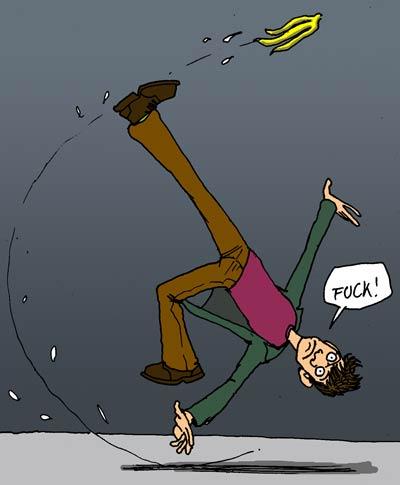
This brings us to another category of humour. Things that are disgusting or related to sex and violence seem to invoke a rather primitive reaction from us, and are effectively used in jokes. Although more popular at a younger age, such jokes do make millions of adults laugh out hard as well. Visual jokes often belong to this category, such as the one put with this post.

But then, many jokes are fairly complex and logical, and the generation of humour often comes simply from the process of reasoning and inferring the joke. These jokes are very similar to logical puzzles, which invoke similar pleasure in the mind of the reader.

Did you hear about the French suicide bomber? Yes, he's on 23rd mission!

It seems that through this little discussion, we have realized that humour is not the result of one simple mechanism, but a group of mechanisms that generate related reactions. Perhaps then, a rigid taxonomy of humour is required, as is a survey of existing philosophical and computational models of humour...

Friday, August 05, 2005

Disclaimer: The following post is not suitable for minors. Adults are advised to read it at their own discretion. The author of this blog takes no responsibilty for the content presented here, and the views expressed are not necessarily shared by the author or Blogger.com.

Jerking off, wanking, spanking the monkey, choking the purple dinosaur, stroking the magic wand of fulfillment... almost anyone with a reasonable grasp over english can come up with a slang for:


Masturbation

In a particular sketch of the British comedy show 'Monty Python's Flying Circus', a contestant on a game show was to declare that his hobbies included "strangling animals, golf and masturbation". The BBC promptly mandated that the word 'masturbation' be silenced out. During one of the negotiations, one of the Pythons, Eric Idle, reportedly asked the head of the BBC, "Everyone masturbates. Don't you masturbate, sir?". He was not given a response.

That was an ideal episode to highlight the taboo associated with talking about masturbation, and the feeling of concern and guilt associated with the act. And old saying goes, '95% of people masturbate - the other 5% lie about it'.

All over the world, boys and girls, men and women, and even other mammals masturbate from 3-4 times a week to about 3-4 times a day. Most consider it a private affair, while others prefer a mutual act. People either use their hands, accessories, sexual partners or friends to get the act done. Millions of young boys and girls discover the pleasures of their genitilia every year, locking themselves in their rooms or taking too long in the bathroom. Even the most liberal parents sometimes worry, while the child almost always frames an uncomfortable and guilt-ridden view of masturbation in his/her head. All a part of growing up!

Many religions consider masturbation a sinful act. Christianity declares any sexual act outside the bonds of marriage as sinful. A very powerful statement made by St. Thomas Aquinas said that masturbation is worse than rape, since rape is a sin against reason alone, whereas masturbation is against the ways of nature as well as reason. It is but obvious then, that christians feel a sense of guilt while commiting the act. However, the private nature of the act manifests itself as guilt and shame even without religion involved.


The myths associated with masturbation are as interesting as the act itself! Personally, I've heard that you go blind if you masturbate too much, or that you lose your sexual urge. There are many more, some very strange indeed, such as you grow hair on your hands, you become dumber etc. Research indicates of course, that masturbation, even when performed often, is physiologically harmless. It's like a mild excercise, and it's only bane is a temporary drop in energy and hormone levels.

Masturbation hasn't inspired art as much as sex has, I'll admit. However, songs have been sung on it or referencing it, and it of course attracts a lot of humour.

We need to be more open about this act than we are. Everyone does it. EVERYONE! The others are lying :)

Monday, August 01, 2005

The Beatles... one of the greatest bands that ever graced the Earth with their music. They started off with popular rock and roll, with the immense hit 'Please Please Me' in 1963. Beatlemania was on - girls screamed and fainted at their performances, guys considered them Gods! Many more albums followed their first, but neither their style nor their popularity ever stagnated. By 1968 they experimented with alternative music, notably in the 'White Album' and 'Abbey Road'. After releasing 'Let It Be' in 1970, and a few compilation albums, the Beatles went their own ways... reaching varying levels of success. Four great musicians, each with their own style and influences:


John Lennon, Ringo Starr, George Harrison and William Campbell.

The four Beatles, who have immortalized themselves as arguably the most successful band ever... err what? Did you say Paul McCartney? The fourth Beatle was Paul McCartney? Ah, well... Paul is dead! He was replaced by a clone years back.

In 1969, an RJ in Detroit named Russell Gibb announced that Paul McCartney was dead. He presented evidence strewn throughout the Beatles' songs, movies and album artwork. Needless to say, the news spread throughout America. Thousands of Beatles enthusiasts around the world started their own little investigations, and the 'evidence' mounted. Many versions of what happened exist:

Apparently, Paul McCartney was found dead at Outreau, North France after suffering a car accident. This brought despair to the remaining Beatles, who thought that this wasn't good for the world and for their careers. Amidst deep mourning for the loss of a great friend, they decided to do all it took to keep The Beatles alive, which meant keeping Paul's death a secret and getting someone to cover for him. During this time, a Paul McCartney look-alike contest was held, and probably the winner William Campbell's prize was to take Paul's place in all photos, album covers, public meets etc. Another theory says it was Geoffery Shepherd, a singer with The Pepperpots Band. Of course the transformation of the look-alikes into Paul was slow and required a lot of effort, including surgeries. However, Beatles fans noted marked differences between the real Paul and who they believed was a clone. The most notable being a scar on the fake Paul's upper lip.

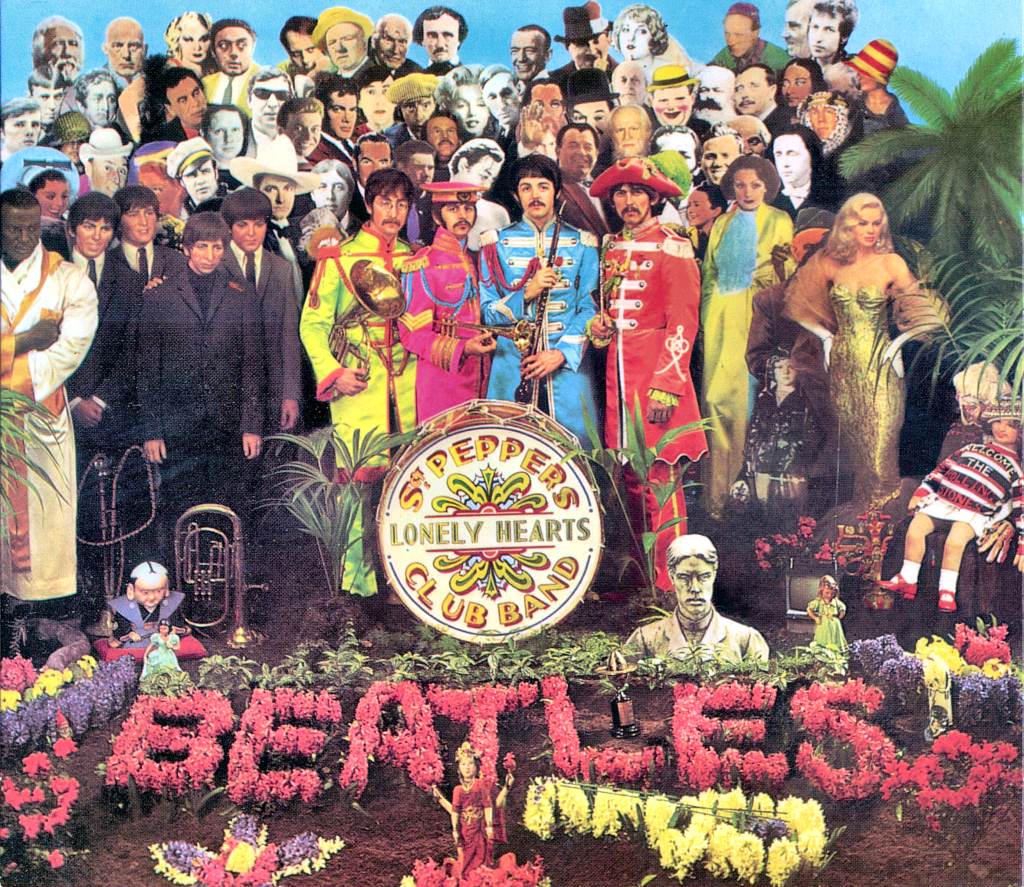
The Beatles themselves deliberately left clues in their album covers and lyrics to gradually reveal that Paul was dead. The first one was the 'Butcher Album', which showed The Beatles holding decapitated baby dolls and raw meat, with George holding a head right next to Paul's head. The album cover of 'Yesterday and Today' shows Paul sitting in a trunk, signifying his burial. 'Sgt Pepper's Lonely Hearts Club Band' had a phenomenal album cover, and brought with it a phenomenal share of controversy as well. A lot of clues, some rather nonsensical, were extracted from this album. For instance, a doll is seated in the far right with a white car in her hand, the same model Paul died in. The album cover of 'Abbey Road', my favourite, seemed like a funeral procession for Paul. Paul was the only one in black , was barefoot, and was out of step with the other Beatles. Lennon was the Preacher, Ringo was a Pall Bearer and Harrison was the grave-digger. Most notably, Paul was left-handed, but in this photo Paul has the cigarette in his right hand! Also a hearse is visible in the background!

Many lyrical clues were also inserted by The Beatles. One very strong clue was that when you play the gibberish at the end of the song 'I'm So Tired' backwards, it sounds like "..Paul's dead man, miss him miss him.."! 'Glass Onion', the title of one of their songs is a moniker for a see-through coffin. Also, Lennon sings in the song, "The Walrus is Paul." In many European countries, a walrus represents death. Many interpretations of other lyrics exist, all indicating Paul's death.

Is Paul really dead? Or is it a hoax? Even if it is one, did the Beatles play an active role in setting up the hoax, or was is just the work of overimaginative fans? Most people today believe the latter. An elaborate hoax that wasn't caused by one person or idea, but rather collectively by enthusiastic fans. However, there still are ardent believers in the theory even today. Hell, they even made a movie about the whole thing. Looks like Beatlemania went far far beyond just screaming and fainting. As long as The Beatles live, so will rumours that Paul is dead.

Just Google 'Paul is dead' to know more...

Saturday, July 30, 2005

She certainly gave science a wish or two...

November 4th, 1970. A middle-aged woman and her mother came into a welfare office in Temple City, California, carrying a small girl who looked to the officer to be just 6 or 7. She was in reality 13, and had lived a life of severe abuse. Genie (real name protected by law), a very unfortunate victim of abuse, was kept locked in a room alone for over 10 years. While awake, she was tied to a potty chair, and slept in a crib with her hands restricted. Her father, who was mentally unstable himself, regarded Genie as a retarded child, and considered his ritual abuse as a way of protecting her.

Genie's peculiar bunny-like walk shocked her rescuers, in which she held her arms like paws in front of her, and walked haltingly. She wasn't toilet-trained, could focus to only a few feet in front of her, could not eat solid foods and spat constantly, and the only words she said were 'stopit' and 'nomore'.

Genie is a feral child, one of several cases of children who have lived many of their formative years without the nurturing environment of a human society. Her case shocked and saddened millions of people, and she found a lot of well-wishers. However, Genie also provided a lot of evidence and food for thought for linguists. She provided a unique, albeit extremely unfortunate case study to investigate the Critical Period Hypothesis, which states that the period from about two years till puberty is critical to the learning of language in a child, and if that period is missed, the child doesn't learn language as proficiently as a normal child would. An easy-to-see support of this hypothesis is that most of us, who have been brought up in a place where the language spoken is not our own, pick up the foreign language with native-like proficiency, whereas our parents still grapple with words and constructions, in spite of being exposed for the same time.

Psychologists, linguists and neurobiologists tracked Genie's progress. During her rehabilition, she was very eager to learn new words, pointing at them until someone told her what the object was called. She rapidly progressed; her acqusition seemed to be just a delayed version (about 12 years) of that of a normal child, only faster! She went through the natural initial phases of language acquisition, until she was stuck at the multiword phrase. Genie just couldn't go beyond saying phrases like "Applesauce buy store" and "No have toy". At the same time, her caretakers were amazed at how quickly she picked up maths and how well she could express abstract thoughts through drawing. It is said that the scientists working with Genie fell in love with her innocence, and often would spend entire days with her.

In Genie's case, however, the Critical Period Hypothesis could not be verified conclusively. Evidence of brain damage was found, although no one was sure whether her brain was damaged from birth or because of the brutal treatment she recieved in her earlier years. It wasn't sure anymore whether her block in acquisition was due to her passing the critical age, or due to the brain damage. In any case, the experiment was scrapped, and today Genie lives in a foster home in southern California.

The case study of Genie was fascinating, but also very controversial. Her mother, and a whole lot of people, ended up thinking that the experimentation on Genie was detrimental to her being rehabilitated and science should have left the poor girl alone, but scientists maintain that they loved Genie like she was their own child. What struck me the most was simply that there was an actual word for children like Genie - 'feral children'... which means it happens often enough to require a name! Depressing...

The movie Mockingbird Don't Sing is based on Genie. Although not an excellent movie, it is worth a watch.
The mind is turned on!

I look down at a familiar white dog that comes out on the lawn and settles down amongst us as if it's one of us, and although I smile at how cute the act looked, I can't help but loathe its utter lack of intelligence. I'm definitely a superior being, I think. And I look so much more handsome, and have far less hair on the chest... and then the mutt looks up to me, and its eyes reflect purity, kindness and intelligence - it's one of God's creatures;
it seems to have a soul. I wonder, what really makes us so different?

Bah! But of course, man is far superior. We're thinkers, we're builders, we're warriors, we're philosophers, we're murderers. We appreciate beauty, we create beauty, we destroy it. I've never seen a bird stop and stare at the sunset, just like I've never seen a dumb monkey electing a dumber one for
President. As a society, we're cultured and complex, and we are rational beings. And of course, we possess the most powerful tool ever created: language! We are above nature. We aren't bound by it, we're beyond it.

My mind dwells on language and culture.
Certain species of monkeys have a set of sounds specifying signals, such as that of food or danger. Parrots and parakeets imitate voices, a songbird can actually piece together bits of songs heard from other birds to make its own composition. Apes (the most famous being Koko) have been taught how to use hand signals to communicate with man. Language, right? Wrong! Even Apes only seem to reach the Multiword Phrase Level, speaking sentences like 'Koko hug', a feat accomplished rather easily by humans before the age of 3, without years of research, training and pampering. The full recursive infiniteness of human language (add 'Google says that' before any declarative sentence to make a new one, for example), a lexical repertoire of over 30,000 words, and the vast array of abstract thoughts detached from time and space that can be expressed... now that's raw power. That's unparalleled, that's human.

On a high, and rather proud of myself, I move to culture and beauty. We appreciate the beauty of the world around us and we create
things purely for aesthetic pleasure. No other being does this, or indeed needs to! Doesn't that put us above nature? Why would nature give us tools we don't need for our survival? Appreciation of art and beauty, kindness, altruism, magnanimity... these are biologically without function or even illogical. Perhaps they aren't... many researchers, notably G.F Miller, say very interestingly that almost every trait we consider uniquely human has risen out of the process of sexual selection. With traits like pure physical strength no longer a parameter for fitness, humans have to rely on other measures of fitness. The appreciation and creation of beauty and art reflect a developed and superior mind, altruism and kindness are an obvious indicator of success, and it is but obvious that courtship in humans employs wit and humour, a definite measure of intelligence. One even dares to say that the entire world of art, of beauty and of charity is here just to help us find mates! Many elements of human sexuality also seem to be deeper than they are. Facial beauty is a direct consequence of symmetry, a measure of genetic health. The large breasts and buttocks of the human female exhibit fitness and energy resources to take care of the soon-to-come young, and hence are naturally attractive to men. Perhaps the expressive power of language, as it is now, is also a result of sexual selection!

Perhaps the character John Keating (
Robin Williams) was right when he said in 'Dead Poets Society' that language was made not to communicate, but to woo women! We seem to think we are above nature, that what we define as human is not needed for survival and hence not dictated by it. We use this to detach ourselves and to elevate ourselves. But we seem to be very much under the control of nature... we're just too intelligent to realize it!

And as science fails to give me some solace, I look back at the dog. It gives me a blank stare, but its soul gives me a smile. I won this battle, it says. The war is far from over, I reply. And I finish the remaning lime juice and move on.